Perspective
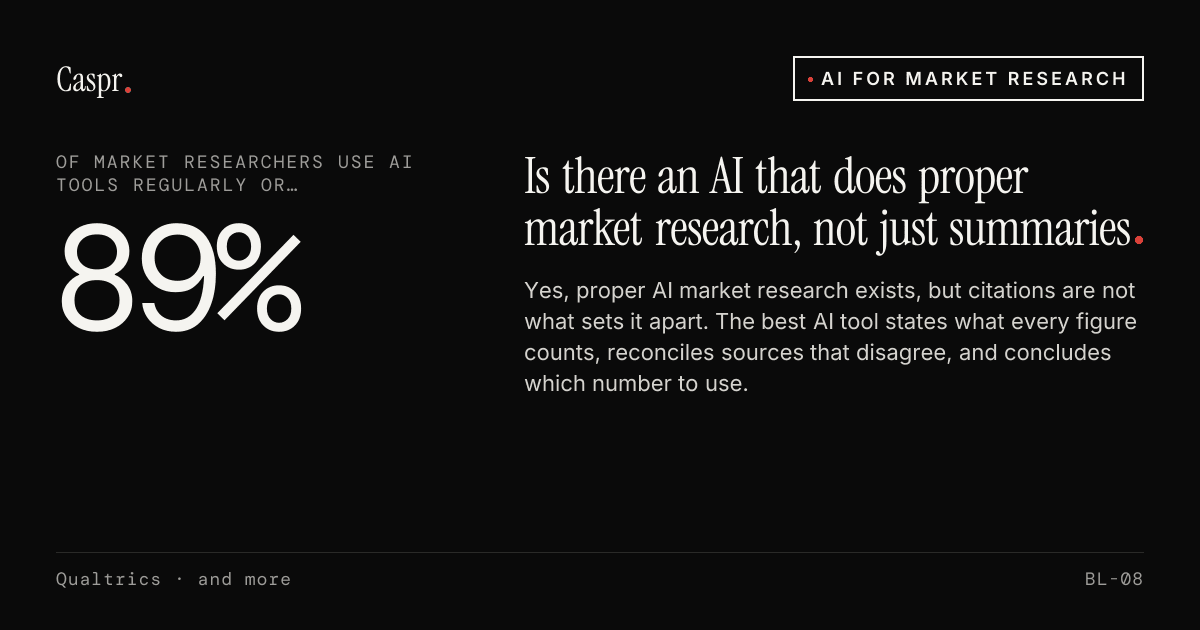
Is there an AI that does proper market research, not just summaries?
Yes, proper AI market research exists, but citations are not what sets it apart. The best AI tool states what every figure counts, reconciles sources that disagree, and concludes which number to use. Judge any tool by what it returns when two credible sources disagree: one well-cited number is still a summary, not analysis.
What does AI market research actually cover?
89% of market researchers already use AI tools, regularly or in trials, according to a Qualtrics survey of more than 3,000 researchers in 14 countries published in October 2024. Adoption is settled. What is not settled is which job the tool was hired to do, because three different jobs travel under the same search term.
The first job is collecting new data: AI-moderated interviews and surveys, and synthetic panels that simulate respondents. The second is finding and summarizing what is already published: assistant deep research modes, answer engines, and AI search inside paid data libraries. The third is AI for market analysis proper: deciding which figures measure the same thing, which genuinely disagree, and which number belongs on the slide.
Most disappointment with AI market research comes from buying the second job and expecting the third. Strategy teams and agency strategists describe the result in almost identical terms: a summary of the internet, when the brief called for a structured argument with a number behind it.
Even the investors funding the category say there is no shared yardstick: a June 2025 a16z analysis noted that no established benchmarks or evaluation frameworks exist, so companies end up defining their own. Caspr's follows.
Why is citing sources not enough?
Citation is the floor, and not every tool clears it. In March 2025 the Tow Center for Digital Journalism at Columbia tested eight AI search tools on 1,600 queries, asking each to name the headline, publisher, date and URL behind a news excerpt. More than 60% of the answers were wrong, most delivered with full confidence; the premium versions erred more often because they declined less. This means a link proves that a source exists, not that it says what the answer claims.
Clearing the floor is still not the test. A citation says where a number came from, not whether it is the right number for the question. Estimates for the same market routinely differ because they count different things: in UK ready meals, four research firms put the 2024–2025 market between $5.75 billion and $8.70 billion; in Saudi industrial valves, published 2025 figures run from $725 million to about $2.09 billion. Every one of those figures can be cited correctly.
A tool that returns any one of them with a clean link has passed the citation test and failed the analysis. The reader inherits the hardest hour of desk research, working out how to reconcile two market size estimates, and usually discovers it in the meeting, when the client has seen the other number.
So the question to put to any AI market research tool is not whether it cites. It is what the tool does when one source says $5.75 billion and another says $8.70 billion.
AI market research tools compared: what is each format built to do?
Lists of the best market research tools usually rank brands. The fair comparison is by format: the deep research modes from OpenAI, Google and Anthropic share one design, Statista and AlphaSense another, and a ranking across them scores tools built for different jobs. The table describes each tool only in the terms its maker publishes, and says so where a maker is silent on sources that disagree.
| Format | Examples, in their makers' terms | Built for | What it returns | Sources that disagree |
|---|---|---|---|---|
| Deep research mode in a general-purpose assistant | ChatGPT deep research: multi-step internet research, with citations (OpenAI). Gemini Deep Research: browses up to hundreds of websites (Google). Claude Research: searches that build on each other, with citations (Anthropic) | Reading many public sources fast | A long report in a chat thread, with links | Not described by the maker |
| AI answer engine | Perplexity Deep Research: a report in two to four minutes, exportable to PDF (Perplexity) | Fast answers to direct questions | An answer or report with source links | Not described by the maker |
| AI search inside a data library | Statista Research AI: answers only from Statista data, with inline citations. AlphaSense Generative Search: broker research, expert calls and filings, cited | Plain-English search of licensed content | A cited answer; AlphaSense also builds slides and reports | Not described by the makers |
| AI for primary research | AI-moderated interviews and surveys; synthetic panels that simulate respondents (as mapped by a16z) | Collecting new data | Responses, transcripts, simulated reactions | A different job: new data, not published estimates |
| Analytical AI | Caspr: a single-line prompt becomes a structured, cited report, PDF or editable PPTX, in under 15 minutes | Reconciling sources and concluding | A structured report, every claim cited | Asked to reconcile, a Market Research Study classes each gap definitional or genuine and recommends a figure |
Read down the last column. Three of the five formats, six named products from OpenAI to AlphaSense, are built to find and present published evidence, and not one of their makers says what happens when that evidence disagrees. Reconciling is simply not the job those formats were built for.
Deep research modes deserve the closest look, because breadth is what they sell: Google says its version browses up to hundreds of websites. Breadth, though, is an input to the problem, not its answer: the more sources a tool reads, the more figures it finds that disagree, and a long report can still hand the reader four market sizes and no basis for choosing.
AI search inside a data library solves a different problem. Statista says its Research AI answers only from Statista data, never the open web. The trade is scope: a figure published outside the library cannot be set against the library's own.
What should you look for in an AI market research tool?
Six tests, each answerable from the first report a tool produces. None needs the benchmark that a16z says the category still lacks.
| Test | Analysis looks like | Summary looks like |
|---|---|---|
| Basis | Every figure states what it counts: product scope, channel, geography, year and currency | A number and a link |
| Disagreement | Conflicting figures side by side, each gap called definitional or genuine | One figure, chosen without saying why |
| Conclusion | A recommended figure or range, and the decision it suits | Estimates vary, followed by a list |
| Declared gaps | States what it could not source and how it estimated instead | Fills the gap with a confident number |
| Structure | Sections a deck or memo can use: market, drivers, competitors, risks, implications | A conversational answer to be rebuilt by hand |
| Currency | Dated sources and an as-of date on the report | Figures of unknown age |
The disagreement test is the fastest. Ask a tool for the size of the UK ready meals market, where four published figures already run from $5.75 billion to $8.70 billion. A tool that returns one number, however well cited, has shown how it will behave on every market where the disagreement is not yet known.
Basis matters as much in valuation as in sizing. Caspr's Study of vertical SaaS valuations treats EV/TTM revenue, EV/NTM revenue and EV/ARR as complementary lenses, not interchangeable ones; a tool that quotes a multiple without its basis hands the reader the comparison error laid out in NTM against TTM revenue multiples.
The declared-gap test applies the Tow Center finding to market data: the premium search tools erred more often because they declined less. A tool that says it found no regional data, and how it estimated instead, beats one that returns a precise regional figure with no visible method.
Caspr's position: buy the reconciliation, not the search
The best AI for market research is the one that does the step a buyer cannot hand to a search box: deciding whether UK ready meals is a $5.75 billion or an $8.70 billion market, and why. It is also the step most AI tools for market research leave with the reader: of the five formats in the table above, only one claims it.
Deep research is sold as a feature of assistant subscriptions: OpenAI released its version first to Pro users, Anthropic to its Max, Team and Enterprise customers, and Perplexity made its own free with a daily cap. Finding sources is close to free; what costs money is the senior time spent turning four market sizes into one. Set against what market research costs when commissioned, the benchmark for an AI tool is the price of a defensible document, not of a login.
A chat thread is a format for questions. A board report, an investment memo and a client deck are formats for arguments: a claim, the number behind it, its source, and what it means for the decision. A tool built for the first format leaves the reader to rebuild the second.
Caspr is built to the second standard. A single-line prompt returns a structured, cited report as a PDF or editable PPTX in under 15 minutes, priced per analysis; a Market Research Study is $80. The worked example below shows what a Study does with four published figures that do not agree.
The position has limits. If the job is new data, such as what buyers think of a concept, no desk research tool is the answer; that needs fieldwork. Synthetic panels are AI-simulated audience response, useful for screening ideas early and never a substitute for real respondents. And for a single fact with one obvious source, an answer engine is the faster tool.
What does this mean for your next decision?
The test is the same for every reader. What changes is the room the number has to survive.
| Reader | The question the room asks | What the tool must hand over |
|---|---|---|
| Consultant or agency strategist | Where did this number come from? | The figure, its basis and source, and the alternatives it beat |
| Strategy team | Can this be attributed to a named source? | Publisher, date and scope note on every figure on the slide |
| Investor | What is the range, and which end does the thesis rest on? | Every credible estimate side by side, with the reason for the base case |
| Founder | Why should an investor believe this TAM? | A sourced top-down figure and a bottom-up cross-check |
| Student | Is this source real, and does it say this? | Citations to original publishers, not secondary copies |
Whichever tool is chosen, run it first on a market whose disagreement is already known, such as Saudi industrial valves, where published 2025 figures run from $725 million to about $2.09 billion. How it handles that spread predicts how it will handle an unfamiliar one.
When a figure is challenged, the answer has to exist before the question does: the publisher, what the figure counts, and why it beat the alternatives. Having all three ready is how a team can defend a market size estimate without leaving the meeting to check. A tool that delivers it is doing analysis. One that does not is a faster way to find the problem.
Worked example
Worked example: UK ready meals, four published figures and one decision
The question: how big is the UK ready meals market? Four research firms answer for 2024–2025: Market Research Future at $5.75 billion (2024), MarkNtel Advisors at $5.86 billion (2025), Deep Market Insights at $8.56 billion (2025) and MarketLine at $8.70 billion (2024). The highest is 51% above the lowest, and each is citable. A summarizing tool returns one of them. Asked to reconcile the estimates, the Caspr Study set out all four and asked what each counts. MarketLine's covers prepared meals including meal kits and pizza; Market Research Future's covers the narrower ready-to-eat category. The Study classed the gap as mostly definitional, not a disagreement about UK demand, and named the drivers: product scope, direct-to-consumer sales, year basis, and the dollar translation of a market earned in sterling. Then it concluded. Three tiers, not one headline: narrow, $5.7 billion to $6.0 billion, for shelf and pricing work; broad, $8.5 billion to $8.7 billion, for total convenience-meal spend; and a mid-range of roughly $6.8 billion to $7.8 billion, inferred between the two, which the Study recommended for deciding whether to enter the market or invest in it. Any board or investor pack, it advised, should show all three tiers on one page. That last step is the one a citation cannot supply, and the difference between a number and a number that survives the room.
Frequently asked questions
What is the best AI tool for market research?
The best AI market research tool depends on the job: AI interview and survey tools for new customer data, an answer engine for a quick cited fact. A market size for a board or investor, like UK ready meals at $5.75 billion or $8.70 billion, needs one that states each figure's basis, reconciles the gap and concludes.
Is ChatGPT market size data reliable enough for investors?
Not on citations alone, though ChatGPT's deep research mode does cite sources, which clears the first bar. Investors ask for more: the publisher, the year, what the figure counts, and why it was chosen over other published estimates. A range, or a single figure without that basis, won't survive a partner meeting, whichever tool produced it.
Which AI actually cites its sources for business research?
Most current AI research tools cite their sources, including assistant deep research modes, answer engines and AI search inside data libraries. Accuracy varies, though: a 2025 Tow Center test of eight AI search tools found more than 60% of source identifications wrong. Pick tools that link to the original publisher and state what each figure counts.
How do you use AI in market research without losing quality?
Use AI for the desk research layer and hold it to an analyst's standard: every figure with a basis, every disagreement explained, every gap declared. Keep methodology, fieldwork and client judgment with people. Run any new tool first on a sector you already know well, so its errors show up before a client sees them.
Can AI size a market for a startup?
Yes, AI can size a startup's market, as long as the figure comes with its basis. Investors test a market size two ways: where the top-down number came from, and whether a bottom-up build of customers and price lands near it. An AI tool should give you both, with sources, not a range with no stated origin.
Try it on Caspr
Build a cited market study of the US pet insurance market for a client pitch next week: market size from three sources, the main players and their share, and the growth drivers.
Run the analysis